Reviviendo el cuerpo

Reviviendo el cuerpo: La ciencia, Frankenstein, y la "chispa vital"
Dates: Oct. 7, 2024 to April 29, 2025
Contact: ghsl-special
El siglo XVIII fue una época de experimentación en Europa. La revolución científica de siglos anteriores y el énfasis en la razón y el aprendizaje promovidos por la Ilustración permitieron a los científicos explorar el funcionamiento de la naturaleza como nunca antes. En este ambiente de investigación científica, el estudio de la electricidad capturó la imaginación de académicos y del público en general. Una vez que los científicos descubrieron cómo crear y almacenar cargas eléctricas, utilizaron la corriente en una amplia gama de experimentos, desde prácticos e informativos hasta entretenidos y extraños. Les interesaba en particular explorar sus posibles usos médicos: ¿cómo afectaba al cuerpo? ¿Podría tratar enfermedades? ¿Reviviría a los muertos?
Esta exposición, y su compañera Reconstruyendo el cuerpo, se crearon en conjunto con la exhibición itinerante de la Biblioteca Nacional de Medicina, Frankenstein: Penetrando los secretos de la naturaleza, que explora el poder de la novela de Mary Shelley para exponer los miedos ocultos de la ciencia y la tecnología a medida que continúan los esfuerzos humanos por penetrar los secretos de la naturaleza.
Experimentos electrizantes
Para comprender la electricidad, los científicos experimentaron con ella de todas las formas posibles.
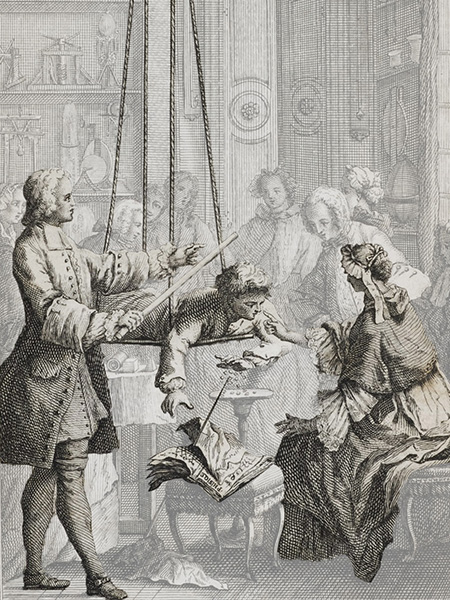
Aquí, Jean Antoine Nollet reproduce el experimento del "niño eléctrico" de Stephan Gray. Un niño cargado eléctricamente cuelga de unas cuerdas de seda aislantes y el científico demuestra cómo los objetos son atraídos estáticamente hacia sus manos. Una mujer se inclina hacia delante para tocar la nariz del niño y recibir una descarga eléctrica. Esta memorable demostración ilustra que el cuerpo humano puede ser conductor de electricidad. Ilustración del frontispicio. Nollet. Ensayo sobre la electricidad de los cuerpos. París: En casa de los hermanos Guerin, 1746.
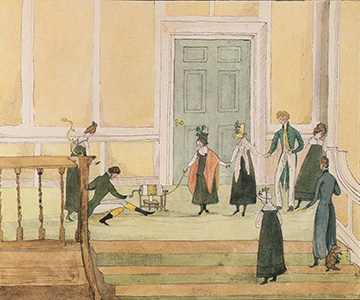
A principios del siglo XIX, las personas no especializadas podían adquirir aparatos eléctricos y realizar experimentos por sí mismos, como en esta pintura donde una familia utiliza una máquina electrificadora para pasar una corriente a través de sus manos unidas. Diana Sperling. 25 de mayo. Electrificación de Henry Van -- Sra. Van, Diana, Harry, Isabella, mamá, y HGS. Dynes Hall, alrededor de 1812-1823. Acuarela.
Galvanismo
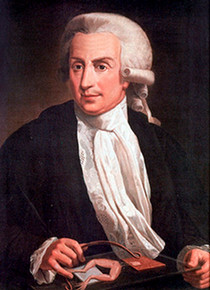 Un científico notable que experimentó con la electricidad fue el médico italiano Luigi Galvani (1737-1798). Utilizando patas de animales disecadas, observó que los músculos se contraían y sufrían espasmos cuando eran estimulados por una corriente eléctrica. Galvani creía que esto se debía a una electricidad interna inherente al tejido animal, a la que llamó "electricidad animal" o galvanismo. En su mente, esta "chispa" física y metafórica era una fuerza vital que animaba a todas las criaturas vivientes. Aunque sus teorías fueron refutadas, la teoría de la "chispa vital" resultó fascinante tanto para los científicos como para los artistas, como Mary Shelley.
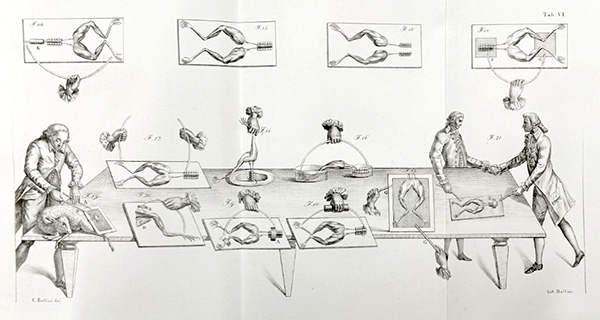
Esta impresión muestra los famosos experimentos de Galvani en los que aplicaba corriente eléctrica a las ancas de ranas en distintas variaciones, lo que las hacía temblar. También se muestran un cordero (Fig. 19) y una pata de gallina (Fig. 20). Tabla VI. Galvani, Luigi. Obra editada e inédita del profesor Luigi Galvano. Bolonia: E. dall’Olmo, 1841.
Maestros de lo macabro
Los científicos realizaron demostraciones públicas de electricidad para experimentar y entretener. El sobrino de Galvani, Giovanni Aldini (1762-1834), llevó los experimentos con animales de su tío un paso más allá: realizó demostraciones públicas utilizando cuerpos de criminales ejecutados, los únicos cuerpos legalmente disponibles para la ciencia en ese momento. En 1803, electrificó el cuerpo de George Foster en la prisión de Newgate en Londres. Durante siete horas, frente a un público asombrado, hizo que el cuerpo se moviera de maneras que, según él, daban una "apariencia de reanimación."
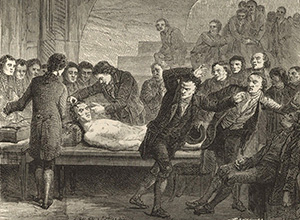 En 1818, el anatomista James Jeffray, con la ayuda del médico Andrew Ure, realizó un experimento similar al de Aldini con el cuerpo de Matthew Clydesdale en la Universidad de Glasgow, que se puede apreciar a la derecha. Aldini creía que el galvanismo podía utilizarse para la reanimación, pero Jeffray y Ure pensaban que la electrificación de un cadáver podría devolverle la vida. "El doctor Ure galvaniza el cuerpo del asesino Clydsdale." En Louis Figuier. Las maravillas de la ciencia. París: Furne, Jouvet et Cie, 1867.
Ure describió meticulosamente los resultados de su experimento y el de Jeffray en un artículo de revista:
[Al estimular el nervio supraorbitario en la frente]... cada músculo de su rostro se puso simultáneamente en acción temerosa; rabia, horror, desesperación, angustia y sonrisas espantosas se unieron para conformar una expresión espantosa sobre el rostro del asesino... En ese momento, varios de los espectadores se vieron obligados a abandonar el apartamento por terror o náuseas, e incluso un caballero se desmayó.
Reviviendo a los aparentemente muertos
A medida que se realizaban experimentos con electricidad, aumentó el interés por la fisiología de la muerte y las posibilidades de reanimación. A finales del siglo XVIII, los médicos habían aprendido a distinguir entre la muerte aparente (cuando el paciente solo parecía muerto y podía ser reanimado con éxito) y la muerte absoluta, que era irreversible.
Naturalmente se especuló con la posibilidad de utilizar la electricidad para resucitar a un paciente que parecía estar muerto. En 1809, el cirujano escocés Allan Burns fue el primero en sugerir una combinación de descargas eléctricas y respiración boca a boca, que ahora se emplea comúnmente como reanimación cardiopulmonar (RCP). Giovanni Aldini también defendió el uso de la electricidad como principal método de reanimación.
Fue en este ambiente científico cuando Mary Shelley (entonces Godwin), de dieciocho años de edad, y su futuro esposo Percy Shelley visitaron la Villa Alpina de Lord Byron en 1816. Para entretenerse, hicieron una competencia para escribir historias de fantasmas; Mary Shelley se decidió por la idea de una criatura creada por el ser humano, reanimada de la muerte.
Galvanismo y Frankenstein
La idea de Galvani de la "chispa vital" influyó en Frankenstein de Mary Shelley. Shelley recuerda su estancia en la villa de Lord Byron en 1816 en el prefacio de la edición de 1831 de Frankenstein:
Muchas y largas fueron las conversaciones entre Lord Byron y Shelley, de las que yo era una oyente devota pero casi silenciosa. Durante una de ellas, se discutieron varias doctrinas filosóficas; entre otras, la naturaleza del principio de la vida, y si había alguna probabilidad de que alguna vez fuera descubierto y comunicado... Tal vez pudiera reanimarse un cadáver, el galvanismo había dado indicios de tales cosas: tal vez pudieran fabricarse las partes componentes de una criatura, reunirlas y dotarlas de calor vital.
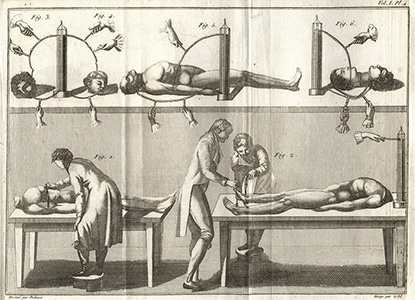
Esta impresión muestra los experimentos de Aldini aplicando corriente eléctrica a cadáveres. Impresión 4, vol. 1. Aldini, Giovanni. Ensayo teórico y experimental sobre el galvanismo. París: Fournier fils, 1804.
Shelley inventa a Víctor Frankenstein, un estudiante de química, cuyas investigaciones lo llevan a descubrir cómo reconstruir y reanimar a un ser humano. Sus experimentos con restos humanos y sus declaraciones hacen eco a las aspiraciones de James Jeffray y Andrew Ure:
...si podía dar animación a la materia sin vida, podría, con el tiempo (aunque ahora me parecía imposible), renovar la vida allí donde la muerte había entregado aparentemente el cuerpo a la corrupción.
Victor borrows the language of galvanism to describe bringing his creation to life:
Reuní a mi alrededor los instrumentos, que infundirían una chispa vital a la cosa sin vida que yacía a mis pies. Era la una de la madrugada; la lluvia golpeaba desoladoramente contra los cristales, y mi vela se hallaba casi consumida, cuando, gracias al resplandor de la luz agonizante, vi abrirse el ojo amarillo y apagado de la criatura; respiró con dificultad, y un movimiento convulsivo agitó sus miembros.
Frankenstein, Volumen 1, Capítulo 4
 Las palabras de Shelley evocan el galvanismo en este punto. Además de la "chispa vital," las convulsiones y agitaciones de la Criatura recuerdan aquellos experimentos con el galvanismo donde se utilizaron corrientes eléctricas para causar la contracción de músculos en animales y seres humanos muertos, haciéndolos parecer vivos. El trabajo de Víctor, ejecutado a la luz de una vela "medio apagada," no solo debe realizarse en secreto, sino que también establece paralelos entre el fuego y la electricidad, y explora los límites entre la vida y la muerte. Frontispicio. Shelley, Mary. Frankenstein. London: Colburn and Bentley, 1831.
De la ciencia ficción a la ciencia real: el DEA
 Aunque Víctor Frankenstein fue un científico ficticio, experimentos como el de Galvani inspiraron verdaderos progresos en el campo de la medicina, como el desarrollo de la tecnología de reanimación. Experimentos posteriores en los siglos XIX y XX condujeron al desarrollo del desfibrilador externo automático (DEA), un dispositivo que utiliza una corriente eléctrica para restablecer un ritmo cardíaco normal en pacientes que experimentan episodios de fibrilación (contracción irregular de los músculos cardíacos) y taquicardia (frecuencia cardíaca anormalmente rápida) potencialmente mortales. En 30 años, los dispositivos DEA se convirtieron en una parte vital de la medicina de emergencia.
Línea de tiempo del DEA
1899 - Fisiólogos italianos demuestran que las corrientes eléctricas pueden tanto detener como reiniciar el corazón
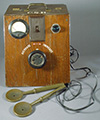
1947 - El cirujano cardíaco estadounidense Claude Beck realiza la primera desfibrilación interna exitosa en un ser humano, colocando paletas (arriba) directamente sobre el corazón del paciente
1950s - El cardiólogo estadounidense Paul Zoll y el ingeniero eléctrico William Kouwenhoven desarrollan desfibriladores externos que utilizan corriente alterna. Son pesados y el voltaje puede lesionar el corazón
1962 - El cardiólogo estadounidense Bernard Lown ayuda a desarrollar un desfibrilador que utiliza corriente continua, que es más seguro y fácil
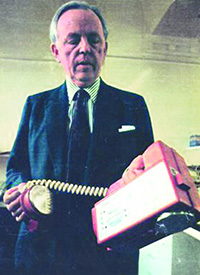
1968 - El cardiólogo norirlandés (arriba) Frank Pantridge desarrolla el primer desfibrilador portátil, que pesa 7 libras
1978 - Se desarrolla el primer DEA portátil “a prueba de errores” para uso de personas no especializadas
1980 - Se coloca quirúrgicamente el primer desfibrilador automático implantable (DAI) en un paciente
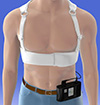
2001 - La FDA aprueba un chaleco desfibrilador cardioversor portátil (arriba)
Credits
Curada y diseñada por Emma Florio, MLIS, Katie Lattal, MA, Lindsey O'Brien, MSLIS; and Annie Wescott, MLIS.
Spanish-language translation provided by Multilingual Connections.
Bibliography
Primary Resources
- Aldini, Giovanni. Essai théorique Et Expérimental Sur Le Galvanisme: Avec Une Série D'expériences Faites En Présence Des Commissaires De L'institut National De France, Et En Divers AmphithéAares Anatomiques De Londres. Paris: Fournier fils, 1804.
- Aldini, John. An Account of the Late Improvements in Galvanism. London: Cuthell and Martin, J. Murray, 1803.
- ———. General Views on the Application of Galvanism to Medical Purposes; Principally in Cases of Suspended Animation. London: Sold by J. Callow [and 2 others], 1819.
- Figuier, Louis. "Le Docteur Ure Galvanisant Le Corps De L'assassin Clydsdale [Illustration]." In Les Merveilles De La Science. Paris: Furne, Jouvet et Cie, 1867.
- Galvani, Luigi, Silvestro Gherardi, Giuseppe Venturoli, and Bassiano Carminati. Opere Edite Ed Inedite Del Professore Luigi Galvano Raccolte E Pubblicate Per Cura Dell'accademia Delle Scienze Dell'istituto Di Bologna. Bologna: Tip. di E. dall'Olmo, 1841.
- Nollet, Jean-Antoine. "[The Electric Boy] [Frontispiece]." In Essai Sur L'electricité Des Corps. Paris: Chez les freres Guerin, 1746.
- Shelley, Mary Wollstonecraft. Frankenstein: Or, the Modern Prometheus. Rev., corr., & illus. ed. London: Colburn and Bentley, 1831.
- Sperling, Diana. "May 25th. Henry Van Electrifying -- Mrs. Van, Diana, Harry, Isabella, Mum, and Hgs. Dynes Hall [Watercolor]." ca. 1812-1823.
- Ure, Andrew. "An Account of Some Experiments Made on the Body of a Criminal Immediately after Execution, with Physiological and Practical Observations." Journal of Science and the Arts 6 (1819): 283-94.

Secondary Resources
- Adee, Sally. "Spectacular Pseudoscience: The Fall and Rise of Bioelectricity." In We Are Electric: Inside the 200-Year Hunt for Our Body’s Bioelectric Code and What the Future Holds. New York: Hachette, February 28, 2023.
- AlGhatrif, Majd, and Joseph Lindsay. "A Brief Review: History to Understand Fundamentals of Electrocardiography." [In eng]. J Community Hosp Intern Med Perspect 2, no. 1 (2012).
- Alzaga, Ana Graciela, Joseph Varon, and Peter Baskett. "Charles Kite: The Clinical Epidemiology of Sudden Cardiac Death and the Origin of the Early Defibrillator." Resuscitation 64, no. 1 (2005): 7-12.
- Ball, Christine M., and Peter J. Featherstone. "Early History of Defibrillation." [In eng]. Anaesth Intensive Care 47, no. 2 (Mar 2019): 112-15
- Bennett, Rachel E. "A Fate Worse Than Death? Dissection and the Criminal Corpse." In Capital Punishment and the Criminal Corpse in Scotland, 1740–1834 London: Palgrave Macmillan, 2017.
- Bertucci, P. "Sparks in the Dark: The Attraction of Electricity in the Eighteenth Century." [In eng]. Endeavour 31, no. 3 (Sep 2007): 88-93.
- Bresadola, Marco. "Medicine and Science in the Life of Luigi Galvani (1737–1798)." Brain Research Bulletin 46, no. 5 (1998/07/15): 367-80.
- Davidson, Luke A. F. "Raising up Humanity: A Cultural History of Resuscitation and the Royal Humane Society of London, 1774-1808." Doctor of Philosophy, University of York, 2001.
- Garde, Ruth. "Charged Bodies: Experiments with Electricity and the Human Body in the 18th Century." Brewminate, 2017.
- MacDonald, Helen. "Galvanising George Foster, 1803 [Edited Excerpt]." In Human Remains. Yale University Press: London, 2006.
- Montandon, Denys. "Frankenstein, the Aesthetic Failure." [In eng]. J Craniofac Surg 31, no. 7 (Oct 2020): 1857-60.
- "The Italian ‘Mad Scientist’ Whose Experiments Inspired Frankenstein." Italian Sons and Daughters of America (ISDA), October 31, 2019.
- Naser, Nabil. "On Occasion of Seventy-Five Years of Cardiac Defibrillation in Humans." [In eng]. Acta Inform Med 31, no. 1 (Mar 2023): 68-72.
- Parent, André. "Giovanni Aldini: From Animal Electricity to Human Brain Stimulation." [In eng]. Can J Neurol Sci 31, no. 4 (Nov 2004): 576-84.
- "The Real Electric Frankenstein Experiments of the 1800s." Atlas Obscura, October 31, 2016, accessed August, 2024.
- Rogers, Kara. "Defibrillation." In Encyclopedia Britannica, 2009; last updated July 18, 2024.
- Ruston, Sharon. Shelley and Vitality. Houndmills [England]: Palgrave Macmillan in association with Arts and Humanities Research Board, 2005.
- ———. "The Science of Life and Death in Mary Shelley’s Frankenstein." Public Domain Review, November 25, 2015.