As research, publishing, and funding systems become increasingly digital and interconnected, managing your scholarly identity is essential. With millions of researchers working across disciplines, institutions, and countries, relying on names alone is no longer enough to reliably connect individuals to their scholarly work. Publications, datasets, grants, and affiliations now move across platforms used by publishers, funders, institutions, and indexing services.
To bridge these systems, the scholarly community developed the Open Researcher and Contributor ID (ORCID), a universally recognized, unique identifier that distinguishes you from other researchers and connects you to your scholarly outputs and professional activities. It stays with you throughout your career, regardless of name changes, institutional moves, or shifts in focus. ORCID is embedded across the scholarly ecosystem and is widely used by publishers, funders, repositories, and research information systems.
ORCID and NIH Compliance
.png) Many journals already require ORCID iDs at submission, and U.S. federal funding agencies are increasingly integrating ORCID into grant workflows. The National Institutes of Health will require use of federal Common Forms for biosketches and Current and Pending (Other) Support, generated through SciENcv starting January 25, 2026 (NOT-OD-26-018).
Many journals already require ORCID iDs at submission, and U.S. federal funding agencies are increasingly integrating ORCID into grant workflows. The National Institutes of Health will require use of federal Common Forms for biosketches and Current and Pending (Other) Support, generated through SciENcv starting January 25, 2026 (NOT-OD-26-018).
As part of this transition, senior and key personnel will be required to have an ORCID iD and link it to their eRA Commons and SciENcv accounts. Get a head start on the NIH’s implementation of Common Forms for Biographical Sketch and Current Pending (Other) Support Documents:
- Sign up for or connect your ORCID to your Northwestern NetID
- Link your ORCID to your eRA Commons Account
- In SciENcv confirm that your ORCID iD is present in the Persistent Identifier (PID) section of the Common Forms. Visit our GalterGuide for more information: Using SciENcv to Create an NIH Biosketch and Other Support Documents.
To support this transition, NIH has released PREVIEW versions of the Common Forms in SciENcv. These previews are not the final forms, and you should continue using the current forms until the change is finalized on January 25, 2026. The preview versions offer researchers an early chance to explore the system, understand the updated instructions, and prepare for the eventual mandate. (PREVIEW) Current and Pending (Other) Support (CPOS) Common Form.
Keep Your ORCID Profile Up to Date with Trusted Data
As compliance requirements take effect, an accurate ORCID profile is vital. Keeping it up to date ensures connected systems share trusted data, reducing manual entry and supporting NIH mandates. Instead of adding each publication or grant across multiple systems, you can authorize trusted services to send verified updates directly to your ORCID profile.
For step-by-step instructions on connecting key systems to your ORCID profile, click on the links below:
- Scopus – for author profile and publication indexing
- Crossref – for journal articles and publisher metadata
- DataCite – for datasets, software, and other non-traditional outputs
- Web of Science – for author profile and publication indexing
- Dimensions – for awarded grants from funders around the world
When these connections are established, your ORCID profile becomes a living profile that updates as new publications, grants, or datasets are registered.
Connect Northwestern Elements to Your ORCID Profile
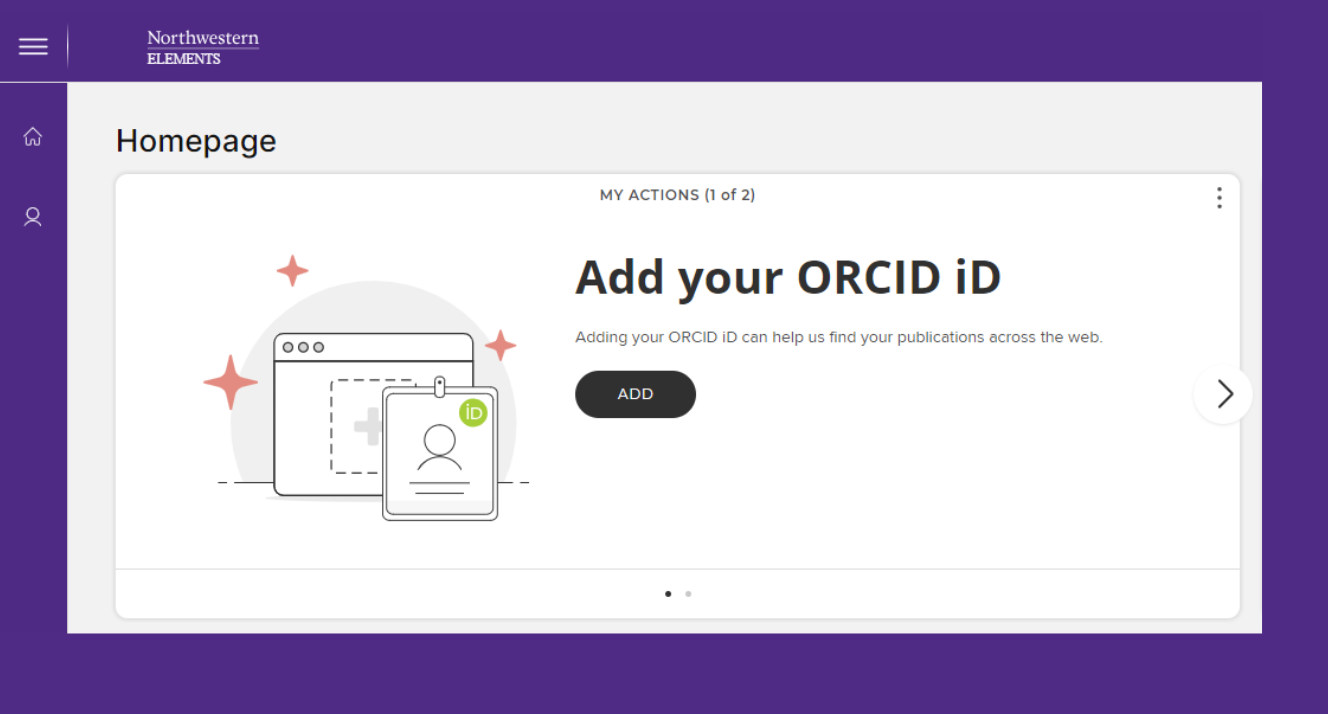 In addition to external funder and publisher systems, institutional systems also rely on ORCID to improve accuracy and reporting. Northwestern Elements supports faculty publication tracking by using metadata from multiple sources to match publications to faculty members, generating lists of publications for Feinberg Faculty Profiles and the Feinberg Faculty Portal.
Connect your ORCID iD to Northwestern Elements to ensure that your profile stays up to date. Faculty members can log into Elements and curate their own publication lists, or they may work with designated departmental super users who have special permissions to manage records on their behalf. For more information, visit our Northwestern Elements GalterGuide to learn how to set up this integration
Support from Galter Library
Managing a digital research identity across multiple platforms can feel complex. Galter Library offers training, guides, and personalized support to make it easier.
- Sign up for Library Classes: ORCID: Register, Use, Share
- Sign up for Using SciENcv for NIH Biosketches and Other Support Documents
- Visit our ORCID GalterGuide
- Visit our Using SciENcv to Create an NIH Biosketch and Other Support Documents GalterGuide
For questions or assistance, contact Galter Library at ghsl-ref@northwestern.edu.
Updated: December 19, 2025