 Proofig AI, a tool designed to support image integrity screening in scientific publications, is now available to Feinberg School of Medicine researchers. The platform can analyze a wide range of scientific visuals, including microscopy, Western blot, in-vivo, and in-vitro images. By incorporating this tool into the research process, investigators can identify and address potential issues early, reducing the risk of delays, corrections, or retractions.
Why Use Proofig AI
 |
|
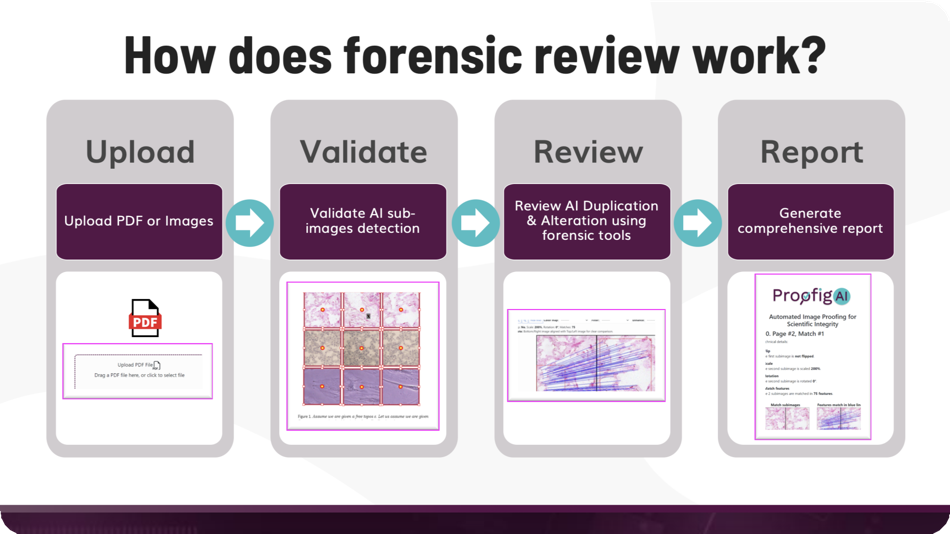
Proofig AI website. Getting started with Proofig: How to Use the Platform.
|
Image integrity has become a growing concern in scientific publishing, with journals reporting an increase in retractions linked to data or image manipulation. These insights underscore the need for proactive screening and strong quality-control measures throughout the publication process.
Despite increasing editorial scrutiny, many image issues originate during figure assembly, where busy research teams rely on manual checks and visual review. Even unintentional errors can raise questions once a paper enters peer review or post-publication analysis. As an automated screening tool, Proofig AI can complement traditional review processes by identifying potential duplication or manipulation before submission.
By integrating this type of tool into the publication workflow, research teams can strengthen their quality-control processes and uphold institutional and funder expectations for transparency and reproducibility.
Access and Support
As a part of Feinberg’s commitment to excellence in research, Proofig AI is provided at no cost to Feinberg School of Medicine researchers. Access Proofig AI here or visit Galter’s Research Integrity Guide for information on best practices for responsible research conduct, authorship, and data management.
For additional questions or assistance contact Galter Library’s reference desk at ghsl-ref@northwestern.edu.
In the event that Proofig AI identifies an issue that cannot be classified as an honest error, cannot be appropriately corrected, has the potential of being research misconduct (falsification/fabrication/plagiarism) and/or if you are unsure, please contact the Office for Research Integrity at Northwestern to navigate these issues, researchintegrity@northwestern.edu.
Further Reading
Bik EM, Casadevall A, Fang FC. The Prevalence of Inappropriate Image Duplication in Biomedical Research Publications. mBio. 2016 Jun 7;7(3): e00809-16. doi: 10.1128/mBio.00809-16.
Else, H. (2024). Biomedical paper retractions have quadrupled in 20 years — why? Nature, 630(8016), 280–281. doi.org/10.1038/d41586-024-01609-0.
Koo, M., & Lin, S.-C. (2024). Retracted articles in scientific literature: A Bibliometric analysis from 2003 to 2022 using the web of science. Heliyon, 10(20). doi.org/10.1016/j.heliyon.2024.e38620.
Updated: December 19, 2025